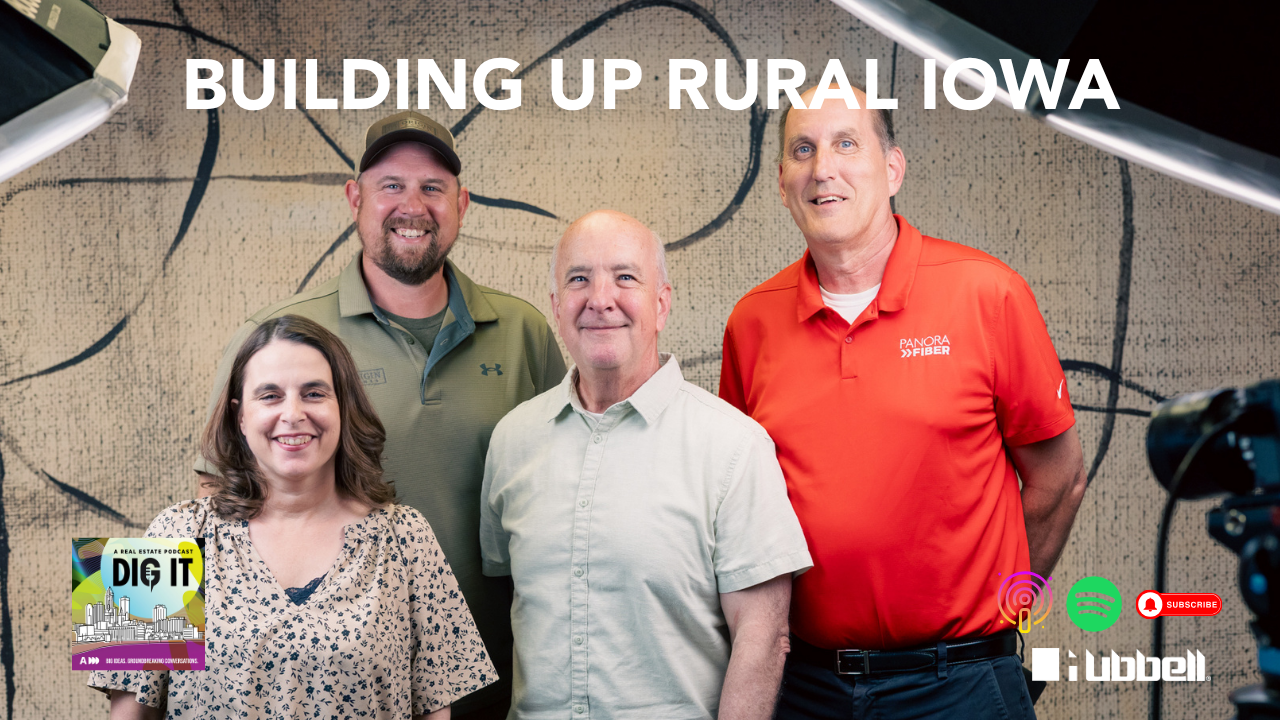
Rural housing initiatives are helping Iowa small towns solve a simple but urgent problem: there are plenty of jobs and community assets, but not enough new construction, move‑in‑ready homes. When employers can’t recruit, schools can’t retain teachers, and families can’t find housing, long‑term growth stalls. On the first episode of Dig It – A Real Estate Podcasts’ fourth season, Origin Homes sat down with three rural Iowa movers and shakers to discuss the importance of rural, attainable housing.
Across rural Iowa, that mismatch shows up in very concrete ways. Superintendents describe losing teachers because they have to commute from larger cities. Mayors see major employers adding positions, while new hires struggle to find anywhere to live within town limits, usually resulting in longer commutes from neighboring towns. Realtors in communities field multiple calls each week from people asking a basic question: “Where can I build a house?”
At the same time, many towns sit on underused assets. That’s where shovel‑ready planning matters.
Former institutional sites, like Knoxville’s old veterans hospital campus, or hayfields on the edge of Panora, had infrastructure potential but no clear path to become neighborhoods… until a public-private plan was proposed and investments were made.
“Housing is no longer a ‘maybe later’ item for rural communities. It’s foundational infrastructure, just like broadband or water,” said Matt Daniels, Director of Operations for Origin Homes.
The lesson for rural leaders is straightforward: housing is paramount. Communities that organize around clear housing needs, prepare build‑ready sites, and invite the right partners to the table are the ones turning empty ground into long‑term population and tax‑base growth.
Inside Origin Homes’ Rural Housing Initiative
Origin Homes’ Rural Housing Initiative is a focused effort to bring attainable, single‑family housing to Iowa towns under 20,000 people, using quality floor plans and deep local partnerships. The company builds in small phases—often three to five homes at a time—so communities can test demand and adjust as they go.
Tools like Iowa State University’s Rural Housing Readiness Assessment and local comprehensive plans help communities identify infill lots, needed price points, and realistic product types. In Brooklyn or Conrad, that might mean a few new homes and targeted rehab. In Panora or Knoxville, it means thoughtfully planned subdivisions with utilities, streets, and tax‑increment‑financing (TIF) structures in place before builders arrive.
Data and experience show that when those pieces align, demand is real. According to Origin Homes’ internal counts shared in recent interviews, the Rural Housing Initiative has produced nearly 40 homes across eight Iowa towns in just three years, with communities like Conrad selling out five‑home phases before completion.
A 2025 report in the Business Record noted that Origin’s rural homes in places like Manning and Jefferson were part of a 28‑home pipeline even before Panora and Knoxville expansions.
Case Study: Knoxville’s Veterans District
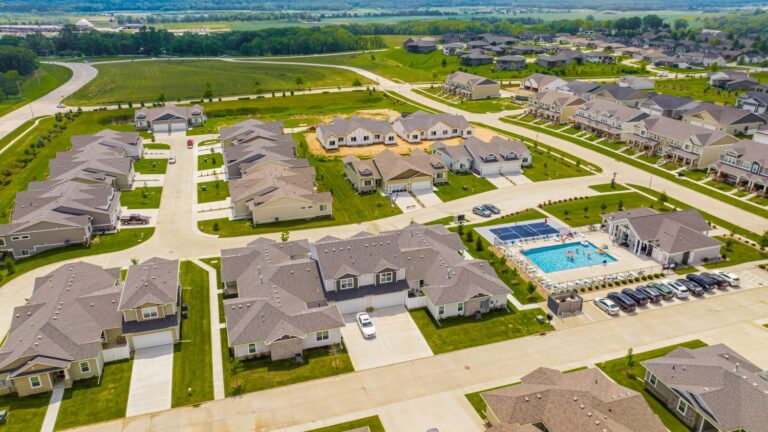
In Knoxville, that work started in the Veterans District, the former federal VA hospital site that sat mostly idle after operations ceased in 2009. In 2020, the city of Knoxville and Marion County took control of the campus, then worked with local partners and realtors to subdivide it into a 34‑lot neighborhood next to a new splash pad, trail connections and future civic amenities. That transformation, from crumbling institutional buildings to fully sold‑out Phase 1 lots in about less than five years, became the proving ground for Origin’s model.
“Origin entered Knoxville as the first major builder in the district, initially committing to five single‑family homes. After those sold quickly, the team returned for second and third rounds, refining elevations, color palettes and layouts based on feedback,” said Sara Roberts, Realtor and Co-Owner of Sundance Realty. “For example, later phases added more variety in facades, a mix of two‑ and three‑stall garages, and alley‑loaded garages so streetscapes emphasize front porches and neighbor interaction.”
Financing has been another critical piece. As highlighted in the Business Record, Knoxville and Origin paired local TIF tools with nearly $400,000 from Iowa’s Workforce Housing Tax Credit program. Knoxville’s mayor Brian Hatch noted that without those credits, new home prices would have been at least $30,000 higher—an unsustainable jump for the local market. Combining state incentives with city‑controlled land let Origin keep prices within reach for first‑time buyers, downsizers and right‑sizers.
Case Study: Panora’s Dream Acres Development
Panora offers a complementary case study. There, a former hayfield became Dream Acres, an 18‑lot subdivision created through a true public‑private partnership. Panora Fiber, a community broadband provider that has served the area for over a century, used its progressive board to step into residential development, something outside its traditional business park focus. Working with the school district and city, the company helped fund and build a brand‑new street, set up a TIF district and prepare fully shovel‑ready lots.
Origin committed to five homes in Dream Acres: three‑ and four‑bedroom ranches with two‑car garages, some with finished basements, ranging from roughly 1,300 to 2,400 square feet and starting in the $300s. Proximity is a key value proposition: the homes sit just two blocks from Little Panther Daycare and Panorama Community Schools, and minutes from Lake Panorama’s trails and recreation.
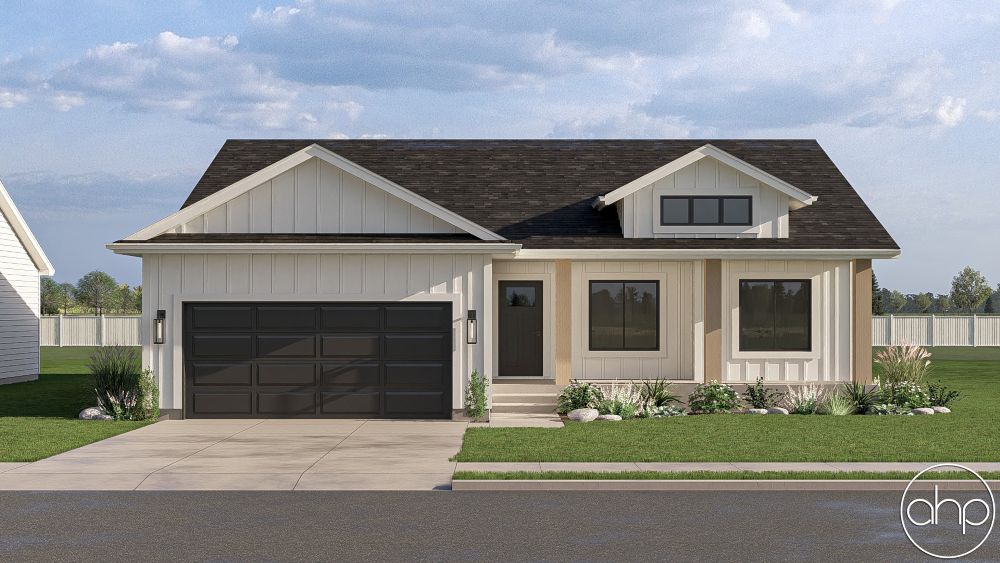
“Origin intentionally designs these rural houses to work for young families buying their first home, professionals moving in from larger metros, and long‑time residents moving off farms or out of aging housing stock. Standardized spec sheets keep pricing controlled, but Origin still offered limited upgrades like backsplashes, appliance packages or basement finishes,” explained Andy Randol, CEO Panora Fiber.
Across all the towns, Origin’s team stresses a few core operating principles:
- work with local trades whenever feasible; each community provides a list of local trades for bid outreach as part of the partnership requirement
- keep communication open with city and economic‑development staff as housing needs change and develop with the market
- stay patient and persistent.
That means vetting area contractors, suppliers and vendors so that framing, concrete and lumber dollars recirculate in the region. It also means recognizing that from first email to ground‑breaking can take years, as it did in Panora’s three‑plus‑year journey from initial introduction to five foundations going in during a cold March.
Empty Lots to Thriving Neighborhoods
Successful rural housing is rarely the product of a single organization. It emerges when city leaders, utilities, state agencies, employers, builders and local advocates all take ownership of the same long‑term goal: growing rural Iowa in a way that actually fits the town.
In Panora, that meant Panora Fiber’s board was willing to see a hayfield as more than marginal ag ground. They leaned into a role most telecoms avoid—residential subdivision development—because multiple housing studies, informal surveys and conversations with groups like the Iowa Area Development Group made the need impossible to ignore.
The Iowa Rural Development Council (IRDC) plays a complementary role at the state level. With just 1.5 staff, the council acts as a “glorified dot‑connector,” bringing together federal agencies, Iowa Economic Development Authority staff, Iowa Finance Authority, Councils of Governments (COGs), Main Street Iowa, and local leaders. Executive Director Bill Menner often encourages very small towns—those under 5,000 residents—to start with manageable steps: a Rural Housing Readiness Assessment, a couple of infill projects, or rehab of derelict properties, rather than immediately chasing a large greenfield subdivision.
Origin’s experience in Jefferson illustrates that infill approach. After testing several lots and proving that new construction would sell, Origin and community could talk more confidently about larger phases. In Conrad, a town of about 1,100, Origin combined five speculative homes with strong city leadership and Main Street capacity; all five sold before completion, validating local demand and giving lenders, employers and residents real examples to react to.
“Employers are an underused but powerful partner in this equation. When major companies or anchor institutions add jobs in towns like Chariton, Oskaloosa or Brooklyn, they have a direct stake in whether new hires can find housing within a reasonable commute,” explained Menner.
Some, like Hy‑Vee in Chariton, have even stepped into the housing business themselves. Others are beginning to collaborate more closely with builders and cities, providing letters of support, land contributions or down‑payment assistance that make projects financeable.
So, What’s Next?
For community leaders, the path forward looks something like this: say yes to the first exploratory meeting, even if you’re not sure what the end product will be; bring all the decision‑makers into one room early—the mayor, superintendent, utility heads, economic development staff, key employers and realtors; and be ready to discuss not just “we need housing” but what kinds of homes your residents are actually asking for. Square footage, bedroom counts, garages, price points and rental versus ownership all matter.
Patience and persistence.
The early results from Origin Homes’ rural work show what can happen when those pieces line up. In three years, the Rural Housing Initiative has moved from idea to nearly 40 completed spec homes in eight towns with more in the pipeline. Knoxville’s Veterans District has gone from shuttered campus to a mixed neighborhood of single‑family homes, with a second phase and school on the way. Panora is turning a hayfield into a family‑friendly street where kids can bike to school and parents can work remotely over fiber broadband.
For rural Iowans tired of hearing that decline is inevitable, these projects offer a different narrative: one where small towns use data, creativity and partnerships to build the homes that keep teachers, attract nurses and engineers, and welcome the next generation of small‑town kids back home.